
Let them make the expensive mistake in the headset.
A new hire practises the real procedure until it is muscle memory. Nothing on your floor gets damaged while they learn.
Run the procedure yourself
Guided steps, scoring and a mentor on call — drag to look, WASD to moveOne course, every screen
The same training program runs on a desktop, in a headset, on a tablet and on a phone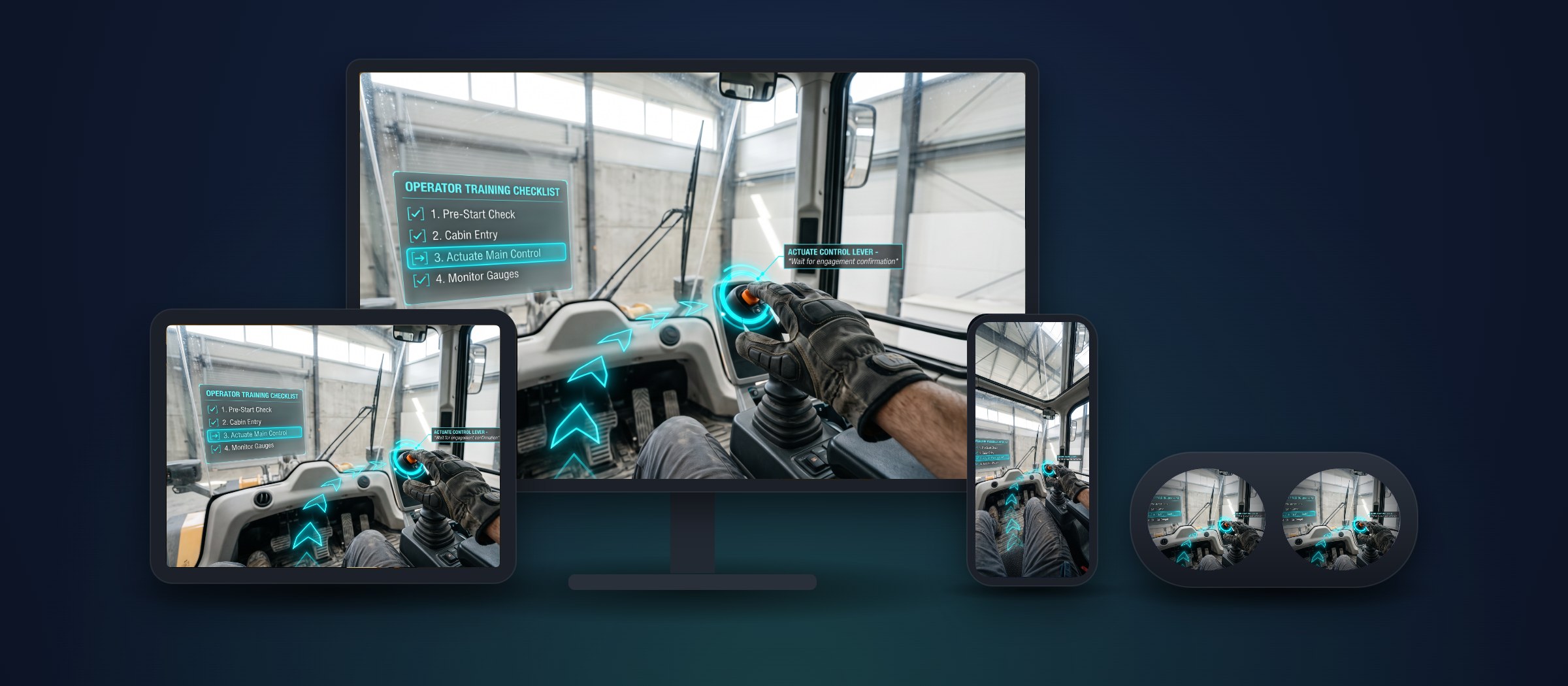
What you are looking at
A trainee working a four-station procedure on a machine tool. Each station lights as they reach it, the panel beside them tracks step, score and elapsed time, and at the fourth station they get stuck — head drops, hands come off the work.
That is when your engineer joins from wherever they are, arrives on the projection disc beside them, and points at the part. The course completes and the attempt is scored. Then it runs again, because that is the whole point.
Price it against your own business
Nothing leaves this page until you send itHow it actually goes
Three moments from the scene aboveWhat you send us
What you get back
Onboarding time on the machines we have built training for, with downtime on the line cut roughly in half.
See the training story →Before you commit
The things worth knowing that a sales page usually leaves out.
You own the course, not a subscription to it
The build is yours: the scenes, the procedure logic, the source project. If you stop working with us it keeps running, and another studio can pick it up. We do not hold your training hostage behind a licence that lapses.
A procedure that changes is a small job, not a rebuild
Machines get revisions. Changing a step, a tolerance or a sequence is an afternoon once the scene exists — the expensive part was building the machine and the room, and that is done. Budget for revisions the way you budget for updating a manual.
It does not replace time on the machine
A trainee who has run the procedure fifty times in a headset still needs supervised hours on the real thing. What VR removes is the early, clumsy, expensive part — the mistakes that damage jaws and scrap parts. Anyone who tells you it replaces the machine entirely is selling you something.
It works badly for judgement, well for procedure
Anything with a right answer and a fixed order trains well: lockout, loading, tool changes, fault clearing. Reading a cut by sound, or deciding whether a casting is scrap, does not — that is years of hands, not a headset.
One procedure is a contained project. Costs rise with the number of procedures, not with the number of trainees. Tell us the machine and we will send a fixed price, in writing, in a few days.
How a procedure becomes a course
The hard part is not the software. It is getting a procedure out of the head of the person who has always done it.
We film the person who knows
A first session is usually two days on your floor with whoever actually performs the task. We record them doing it, then have them narrate it, then ask what a trainee always gets wrong. That third question produces the most valuable material and is almost never written down anywhere.
Wrong answers are the point
A procedure with no failure states teaches nothing. Every step carries the mistakes a trainee genuinely makes — the steel bar instead of the brass drift, the guard opened before isolation — and the headset lets them make it, see the consequence, and repeat until the right action is automatic.
Tracked, scored, and reportable
Every attempt records who, when, which steps, how long, and what went wrong. That produces a completion record you can put in front of an auditor, and it shows you which step in your own procedure trips people up — which is usually a documentation problem, not a trainee problem.
It runs where your people are
A trainee at another site runs the same course on the same day, taught identically. No trainer travel, no machine taken off production, and no waiting for the one person who knows the job to be free.
Where this is the wrong answer
If the task is genuinely simple, or you hire one person a year, VR training will not repay the build. A well-made video and a competent supervisor does the job.
It pays when the machine is expensive to damage, when the consequence of a mistake is an injury, or when you are training the same procedure repeatedly across sites.
Questions we get asked
Does VR training actually reduce onboarding time?
On the procedures we have built, onboarding time falls roughly 30% and machine downtime for training falls by about half. The saving comes from trainees arriving at the machine already knowing the sequence, so supervised time on a live machine is spent confirming rather than teaching.
How many procedures can we start with?
One. We recommend starting with a single procedure — usually the one that causes the most damage or the most repeated questions — because it establishes the format at a contained cost. Additional procedures are substantially cheaper once the machine model and interaction framework exist.
What hardware do our trainees need?
A standalone headset such as a Quest 3 is the usual choice: no cables, no host computer, and it can be handed across a table. Courses also run on a laptop or tablet for revision, though the physical procedures are worth doing in the headset.
Can we prove someone completed the training?
Yes. Each attempt is logged with the trainee, timestamp, step-by-step performance and outcome. Records export for your quality system or for an auditor.
Do we need to write the procedure first?
No, and most clients cannot. Part of the work is extracting the procedure from the person who performs it, which usually produces the first accurate written version of the task your company has ever had.
What does a machine day of lost production cost?
Manufacturers we work with typically put it between €1,000 and €4,000 depending on the machine and the order book. Multiply that by the days a machine is tied up training and the arithmetic for a build usually answers itself.